

Strategic investment in innovation
More than just a financial reward, this fellowship program is a strategic investment in the future of healthcare and basic science. Each successful candidate benefits from his or her own research funds, giving them the autonomy to advance their specific projects while taking advantage of CI2B‘s world-class infrastructure and collaborative environment. The total investment for this initial two-year period exceeds $1.6 million, a concerted effort funded by Fondation Courtois and the host researchers.
This financial commitment enables these “rising stars” to devote themselves entirely to high-impact research, ranging from neuroprosthetics and Alzheimer’s disease modeling to fungal virulence and immune system dynamics. The program highlights graduates from institutions in Canada, the USA, Japan, Brazil, India and Iran.
Meet the CI2B 2025/2026 Fellows
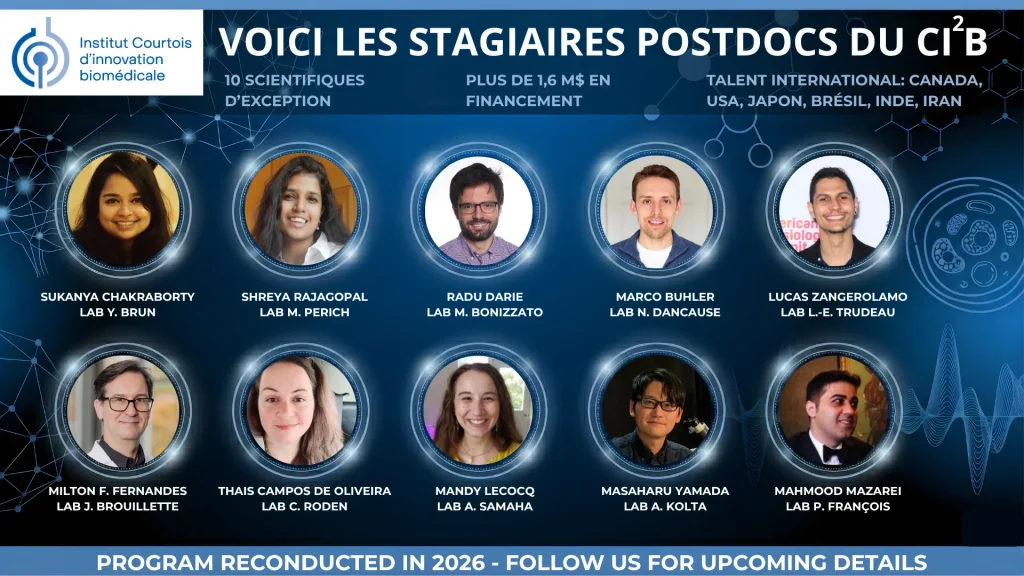
The diversity of projects reflects the interdisciplinary spirit of the Institute. Each fellow is integrated into a specialized laboratory, bridging the gap between fundamental discovery and clinical applications.
Sukanya Chakraborty (Lab Yves Brun)
Specializing in bacterial cell biology and biophysics, Dr. Chakraborty studies the molecular mechanisms governing the transition between motile and sessile states in Caulobacter crescentus. Her work aims to clarify the formation of bacterial biofilms, with direct implications for infection control and the fight against antimicrobial resistance.
Radu Darie (Lab Marco Bonizzato)
A specialist in neuroengineering, Dr Darie is developing autonomous neural interfaces driven by artificial intelligence. His project uses Bayesian optimization and reinforcement learning to personalize spinal cord stimulation, with the aim of restoring motor function in spinal cord injury patients.
Shreya Rajagopal (Matthew Perich Lab)
At the intersection of computational neuroscience and mental health, Dr. Rajagopal is developing a unified model of hippocampal conceptual learning. Her research simulates memory deficits observed in PTSD and Alzheimer’s disease to predict the effectiveness of future therapeutic interventions.
Thais Campos de Oliveira (Lab Christine Roden)
Dr. Oliveira is exploring “mitoviruses” – RNA viruses that replicate in the mitochondria of fungi – as potential biocontrol agents against pathogenic fungi. Using the agent of Dutch elm disease as a model, her work addresses the ecological challenges associated with the climate-induced spread of pathogens.
Masaharu Yamada (Lab Arlette Kolta)
Combining clinical dental expertise and neuroscience, Dr. Yamada studies the role of astrocytic signaling in chronic jaw muscle pain. His project seeks to identify new therapeutic targets for conditions such as fibromyalgia and temporomandibular disorders.
Lucas Zangerolamo (Louis-Éric Trudeau Lab)
Focusing on the spatiotemporal dynamics of dopamine, Dr. Zangerolamo seeks to understand why dopaminergic neurons are particularly vulnerable in Parkinson’s disease. His research uses advanced imaging and optogenetics to identify strategies to mitigate neurodegeneration.
Milton Forestieri Fernandes (Lab Jonathan Brouillette)
Dr Fernandes is tackling age-related vulnerability to beta-amyloid oligomers in Alzheimer’s disease. By integrating single-cell transcriptomics and human stem cell models, he aims to identify the molecular pathways that ensure cellular resilience.
Mahmood Mazarei (Lab Paul François)
With a background in theoretical physics, Dr Mazarei applies computational frameworks to immunology. His project models the interactions between T lymphocytes and antigens to understand the variability of the immune response, contributing to the design of next-generation CAR-T cancer therapies.
Mandy LeCocq (Lab Anna Samaha)
An expert in behavioral neuroscience, Dr. LeCocq analyzes the circuits of the basolateral amygdala (BLA) involved in reward-seeking behaviors. Using optogenetics, she studies how environmental cues influence addictive behaviors, laying the foundations for the treatment of substance use disorders.
Marco Bühler (Lab Numa Dancause)
Dr. Bühler’s research focuses on the reorganization of premotor networks following stroke. Using repetitive transcranial magnetic stimulation (rTMS) in macaque models, he aims to develop targeted neuromodulation strategies to improve clinical motor recovery.
Strengthening our scientific community
The presence of these ten researchers greatly enriches the CI2Becosystem. By bringing diverse perspectives – from clinical dentistry and physics to forestry and neuroengineering – the fellows foster a culture of interdisciplinarity essential to solving complex biomedical problems. Their projects not only advance their respective fields, but also strengthen the collective expertise of the Université de Montréal and its affiliated partners.
The success of this first competition has reinforced the Institute’s commitment to this program. We are pleased to announce that the postdoctoral fellowship competition will be renewed in 2026, continuing our efforts to support the brightest minds of tomorrow and consolidate Montreal’s position as a global hub of biomedical innovation.