
Documents à télécharger
Institut Courtois d’innovation biomédicale, Faculté de médecine, Université de Montréal
L’Institut Courtois d’innovation biomédicale (CI2B) est une initiative majeure de la Faculté de médecine de l’Université de Montréal. Sa mission est de percer les mystères du vivant grâce à une recherche fondamentale de pointe.
Le CI²B rassemble plus de 45 chercheuses et chercheurs des cinq départements de sciences fondamentales de la faculté, ainsi que les membres de leurs équipes. Celles-ci favorisent l’intégration de méthodes quantitatives et d’approches novatrices, en s’appuyant sur des plateformes technologiques de pointe pour mieux comprendre le fonctionnement des organismes vivants, de la molécule unique à leur organisation en systèmes cellulaires complexes. Nos recherches approfondies sont consacrées aux axes de recherche prioritaires de l’Institut, soit la 1) biologie structurale et computationnelle 2) la pathogénèse et la physiologie microbienne 3) la neurobiologie et les neurosciences des systèmes et 4) la physiopathologie moléculaire et les dynamiques cellulaires. Nous partageons ouvertement nos données, nos idées et nos outils avec la communauté scientifique mondiale afin d’accélérer les progrès et de libérer le plein potentiel de nos découvertes.
Située dans la province de Québec au Canada, Montréal offre un mélange unique de charme européen et de dynamisme nord-américain, avec sa gastronomie de renommée mondiale et une scène culturelle riche, animée par d’innombrables festivals et événements. Au-delà de son atmosphère vibrante, Montréal bénéficie d’un marché du travail florissant, d’un coût de la vie abordable et d’une communauté bilingue et accueillante. De ses parcs et espaces verts magnifiques à sa vie nocturne et sa scène artistique dynamiques, Montréal offre une qualité de vie exceptionnelle.
Le CI2B sollicite des candidatures de stagiaires postdoctoraux talentueux pour un programme de bourse de deux ans.
Objectifs du programme
Ce programme vise à :
- Attirer et assurer la rétention des meilleurs chercheuses et chercheurs postdoctoraux de partout à travers le monde et/ou présents à l’Université de Montréal (UdeM), futurs chefs de file dans les domaines et sujets reliés aux priorités stratégiques de l’Institut Courtois d’innovation biomédicale (CI2B), de la Faculté de médecine, UdeM;
- Encourager le développement de projets de recherche collaboratifs et appliqués de pointe.
- Offrir une expérience immersive au sein de l’écosystème de l’UdeM.
Description du financement
Le montant annuel alloué comprend le salaire complet du ou de la stagiaire postdoctoral(e), conformément aux principes établis par l’Université de Montréal. Cela inclut un salaire annuel pouvant atteindre 63 819 $ CA, en plus des avantages sociaux complet, et une allocation de recherche de 20 000$.
La durée totale du financement est de maximum deux ans.
Cet octroi ne peut être cumulé avec une autre bourse nominative d’un organisme subventionnaire de manière à dépasser le montant maximal de cet octroi (par exemple, CRSNG, CRSH, IRSC).
Les candidates et candidats provenant de pays admissibles à l’aide publique au développement du Canada peuvent, sur demande, se faire rembourser leurs frais de réinstallation au Québec, conformément aux règles de ce programme.
Critères d’admissibilité
La candidate ou le candidat doit :
- Avoir obtenu son doctorat (Ph. D.) moins de trois ans avant le début du financement; ou prévoir obtenir son doctorat avant le début du financement; et
- Être inscrit(e) comme stagiaire postdoctoral(e) auprès d’un chercheur membre du Ci2B à l’Université de Montréal au moment du début du financement; et
- Obtenir le support écrit, à joindre avec le dossier de candidature, d’une chercheuse ou d’un chercheur membre du CI2B afin de mener un projet scientifique de 2 ans dans le laboratoire et;
- Maintenir son statut de stagiaire postdoctoral(e) pendant toute la durée du financement (2 ans).
Les candidatures des groupes sous-représentés sont fortement encouragées*.
La superviseure ou le superviseur doit :
- Être membre régulier de la Faculté de médecine et du CI2B.
- Occuper l’un des postes admissibles suivants: professeur.e (incluant les professeur.es sous octroi) au rang d’adjoint.e, agrégé.e ou titulaire.
- Ne pas être ou avoir été le directeur(trice) ou le codirecteur(trice) de thèse de la candidate ou du candidat.
Processus de candidature
Les candidates et candidats doivent soumettre leur dossier de candidature complet à [email protected].
Les candidatures soumises après la date limite ne seront pas prises en considération.
Le dossier de candidature doit inclure :
- Résumé non scientifique. Veuillez fournir un résumé de votre projet de recherche dans un langage clair et simple (maximum 200 mots).
- Le formulaire de candidature disponible pour téléchargement en haut de page;
- La description de votre projet potentiel (maximum 3 pages ; les références peuvent être listées sur une page supplémentaire). Fournir une description détaillée de la recherche proposée, et notamment des éléments suivants :
- les objectifs du programme de recherche proposée,
- les questions ou les hypothèses de recherche,
- la place des travaux de recherche proposés par rapport aux connaissances actuelles dans le domaine,
- une explication de l’originalité et de l’importance potentielle de la recherche proposée,
- la méthodologie (y compris les échéances) et pourquoi elle a été retenue,
- les grandes lignes des plans de collaboration,
- la contribution qu’apportera la recherche à l’avancement des connaissances.
- Une lettre de motivation (maximum 2 pages) expliquant le profil de carrière envisagé et la pertinence du stage postdoctoral dans ce contexte ;
- CV commun canadien format IRSC académique;
- Vos relevés de notes officiels du doctorat (veuillez expliquer le barème de notation dans le cas des universités non canadiennes);
- Au moins deux lettres de recommandation;
- Vous devez également inclure une lettre d’appui d’une superviseuse ou d’un superviseur admissible, ayant accepté de soutenir votre candidature.
Les candidatures peuvent être soumises en anglais ou en français.
Date limite pour postuler : 31 août 2026
Continuer votre lecture afin de connaître une sélection de projets disponibles chez nos chercheuses et chercheurs ci-bas. N’hésitez pas à les contacter directement si vous voyez un lien avec vos ambitions de recherche afin d’évaluer la possibiliter de présenter une candidature.
*Consultez le formulaire de candidature pour les définitions appropriées.
Plusieurs projets disponibles!
Les projets décrits plus bas ont été soumis par les chercheuses et chercheurs principaux du CI2B. Vous pouvez les contacter afin de discuter de cette opportunité avant de soumettre votre candidature. Vous pouvez également adapter votre candidature en fonction d’un des projets affichés. Chaque projet n’est pas obligatoirement associé à une bourse. L’application sera sujette au même processus d’évaluation selon le financement disponible.
Rules of coexistence in polylysogenic genomes
Superviseure: Frédérique Le Roux
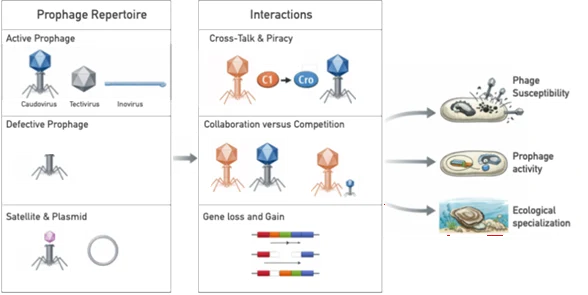
Bacterial genomes are not solitary entities but host dense assemblages of mobile genetic elements, including prophages, plasmids, and satellites. In polylysogenic bacteria, multiple prophages coexist within the same genome, yet the principles governing their organization and interactions remain unknown. This represents a gap in our understanding of phage-bacteria dynamics, still interpreted through simplified one phage-one host models.
Using the natural system Vibrio crassostreae, we recently showed that bacterial populations are structured by diverse and dynamic mobile elements, including active and cryptic prophages, as well as hybrid entities such as phage-plasmids and satellite-plasmids. These elements encode defense systems, regulatory modules, and recombination functions, suggesting that bacterial genomes behave as ecosystems of interacting genetic entities.
We propose that prophage coexistence is governed by underlying rules—based on compatibility, exclusion, and dependency—that determine which combinations of elements can persist within a genome. We further hypothesize that these interactions, rather than individual prophages alone, shape both phage infection outcomes and ecological specialization of bacterial populations across contrasting habitats.
To test this, we will integrate large-scale comparative genomics with targeted functional analyses to (i) redefine prophage diversity beyond current detection biases, (ii) uncover rules of coexistence among co-resident elements, and (iii) determine how these rules influence prophage activity, antiviral defense, phage susceptibility, and ecological specialization. By moving beyond reductionist models, this project will establish a new framework in which bacterial genomes are viewed as structured communities of mobile elements, reshaping our understanding of viral ecology, bacterial adaptation, and microbial evolution.
References
Liang et al. Complex temporal dynamics of phage–bacteria populations in an animal-associated marine system. Nature Communications, in press.
Site web du laboratoire pour publications récentes et contact: lerouxlab.org
Development of ultraperformant data processing pipelines to drive Adaptive Closed-Loop Neurostimulation for Motor Recovery
Superviseur: Numa Dancause
The project’s overarching aim is to develop a pipeline that supports adaptive closed-loop neurostimulation system to advance personalized therapies for movement disorders and the next-generation neuroprostheses. It incorporates advanced signal processing and optimization approaches to ensure low-latency, high-accuracy, and adaptive operation. It is part of ongoing research effort in our group at the Pavillon Desmarais financed by Brain Canada : the platform EthoLab that will support neural recording and stimulation in animal models in the context of naturalistic behaviors.
The project integrates features derived from action potentials (spikes) and local field potentials, recorded from chronic intracortical microelectrode arrays, with synchronized behavioral data collected during motor tasks. By leveraging these complementary neural signals, the postdoctoral trainee will use data-driven models to decode movement-related brain states, including motor intent, preparation, and movement onset, in real time. This will enable state-dependent stimulation with precise temporal, spatial, and parametric control through optimization of timing, cortical target, dose, pulse width, and frequency.
The project will involve:
- Developing, analyzing, and optimizing real-time, data-driven pipelines for preprocessing and spike and LFP feature extraction from large-scale intracortical recordings.
- Conducting neural recording and neurostimulation studies in behaving non-human primates.
- Developing, training, and validating offline models using pre-recorded large-scale neural and behavioral datasets, including synchronized video and force-sensor measurements.
- Translating models from offline training to online closed-loop implementation in preclinical models.
Collaborating with interdisciplinary neuroscience, engineering, computational and clinical rehabilitation teams.
The lab is part of multiple research groups with research interest in fundamental biomedical research (CI2B), bridging neurosciences and artificial intelligence (Union Neurosciences et Intelligence Artificielle – Québec; UNIQUE), and brain function and learning (Centre Interdisciplinaire de Recherche sur le Cerveau et l’Apprentissage; CIRCA)
Mechanistic and structural dissection of let-7 maturation regulators
Superviseure: Pascale Legault
This project aims to define the mechanistic and structural basis of let-7 microRNA maturation by determining how specific regulatory proteins and complexes control distinct steps of miRNA biogenesis. Building on an RNA-centric interactome of the human let-7 family, expanded through integrated computational analyses and supported by initial functional validation, this project focuses on elucidating the roles of prioritized candidate regulators. Quantitative in vitro assays with purified components will be used to test direct interactions between candidate proteins, pre-let-7 RNAs, and core processing factors, including Dicer, Drosha, and Argonaute 2, to define how regulation occurs at distinct steps of miRNA maturation. Key regulatory assemblies will then be reconstituted and structurally characterized by cryo-electron microscopy, and structure-guided mutagenesis will link molecular interfaces to function, establishing a mechanistic and structural framework for miRNA regulation in development and disease.En stimulant spécifiquement les circuits de récompense impliqués dans l’apprentissage moteur, cette approche pourrait immédiatement améliorer la motricité tout en facilitant une récupération durable du contrôle volontaire. Nous utilisons une DBS adaptive et en boucle fermée pour façonner l’exécution du mouvement pendant l’entrainement en réadaptation.Le projet vise à démontrer l’efficacité de cette modalité de DBS, une technologie utilisée cliniquement pour d’autres indications (Parkinson, dystonie) mais encore inexplorée pour la paralysie. À terme, cette stratégie pourrait devenir un traitement clinique innovant pour les personnes vivant avec une paralysie.
For more information about the Legault lab, click HERE
Neurovascular interactions and cerebral blood flow regulation.
Superviseur: Ravi Rungta
We are seeking highly motivated postdoctoral fellows to join a multidisciplinary research program investigating neurovascular interactions and cerebral blood flow regulation.
Our lab research activities are centered around three main themes: 1) The relationship between neural circuit activity and hemodynamic signals, 2) The physiology and functions of brain pericytes, and 3) Neurovascular dysfunction in models of stroke and small vessel disease. We combine state-of-the-art optical methods, including two-photon, mesoscopic optical imaging, and ultrasound imaging, with molecular and pharmacological manipulations to probe neurovascular function in both healthy and disease contexts.
The lab offers a highly collaborative and interdisciplinary environment at the interface of neuroscience and engineering. Fellows will have the opportunity to develop independent, project-driven research programs while gaining expertise in cutting-edge imaging, quantitative analysis, molecular approaches.
Lab website: www.rungtalab.com
Innovation Fellow in Motor Cognition
Superviseurs: Becket Ebitz & Matt Perich
The Ebitz and Perich labs in the Department of Neurosciences at the Université de Montréal are recruiting a postdoctoral fellow for a project at the interface of cognitive and motor control. The way that people respond to the world depends on the information we are holding in mind: working memory profoundly shapes sensorimotor control processes, even when the contents of that memory are completely irrelevant to the task at hand. The goal of this project is to understand how hierarchies of working memory shape sensorimotor control signals within large populations of neurons. The ideal candidate would focus on analyzing existing datasets and developing cutting-edge computational models. There is also an opportunity to lead causal perturbation studies that would combine large-scale neural recordings with electrical stimulation.
http://ebitzlab.com
Postdoctoral training in the neuroscience of naturalistic foraging behavior
Superviseur: Paul Cisek
Our lab studies the neural mechanisms of decision-making and interactive behavior using a combination of computational modeling and experimental techniques in humans and non-human primates. The successful applicant will lead innovative new experiments that examine how decisions are made during naturalistic foraging behavior. This will involve wireless multi-electrode recordings in the cerebral cortex and basal ganglia in two behavioral scenarios: 1) in a controlled virtual reality setting; and 2) during unconstrained behavior in a large enclosure equipped with cameras for automated motion capture. The applicant will help to design and conduct behavioral and neurophysiological experiments, analyze data, develop computational models of neural systems, prepare manuscripts for publication and participate in international conferences. Prior experience in experimental neuroscience is highly desirable, but we encourage applications from all students with a strong background in biology, psychology and/or mathematics and a passion for systems-level study of the brain. For more information, see: https://cisek.org/pavel/.
paul.cisek AT umontreal.ca
LINE-1 and Alu RNAs in RNA Metabolism and Immune Signaling
Superviseur: Daniel Zenklusen
The human genome harbors a vast repertoire of repetitive elements, many of which originate from retrotransposon insertions. Although the majority are epigenetically silenced, a subset remains transcriptionally active. These elements can be expressed either as independent transcriptional units or as part of host gene transcripts, particularly when embedded within introns.
Notably, the expression and/or stabilization of specific repeat elements—especially Alu and LINE-1 sequences— is frequently observed in cancer. Accumulating evidence indicates that these RNAs can engage and modulate innate immune signaling pathways. Despite these observations, the mechanistic basis underlying repeat element regulation, processing, and function remains poorly understood.
The project will employ a combination of single-molecule and super-resolution microscopy, alongside genomic and cell biological approaches, to uncover the mechanistic features of repeat element biology and their interplay with innate immune pathways, with a particular focus on LINE-1 and Alu RNAs.