
Documents to download
Courtois Institute for Biomedical Innovation, Faculty of Medicine, Université de Montréal
The Institut Courtois d’innovation biomédicale (CI2B) is a major initiative of the Université de Montréal’s Faculty of Medicine. Its mission is to unravel the mysteries of life through cutting-edge fundamental research.
The CI²B brings together more than 45 researchers from the faculty’s five fundamental science departments, as well as the members of their teams. They foster the integration of quantitative methods and innovative approaches, relying on cutting-edge technological platforms to better understand how living organisms function, from single molecules to their organization into complex cellular systems. Our in-depth research is dedicated to the Institute’s priority research areas: 1) structural and computational biology, 2) microbial pathogenesis and physiology, 3) neurobiology and systems neuroscience, and 4) molecular pathophysiology and cellular dynamics. We openly share our data, ideas, and tools with the global scientific community to accelerate progress and unlock the full potential of our discoveries.
Located in the province of Quebec, Canada, Montreal offers a unique blend of European charm and North American dynamism, with its world-renowned gastronomy and rich cultural scene, animated by countless festivals and events. Beyond its vibrant atmosphere, Montreal boasts a thriving job market, an affordable cost of living and a welcoming, bilingual community. From its beautiful parks and green spaces to its vibrant nightlife and arts scene, Montreal offers an exceptional quality of life.
CI2B invites applications from talented postdoctoral fellows for a two-year fellowship program.
Program objectives
This program aims to :
- Attract and retain the best postdoctoral researchers from around the world and/or present at the Université de Montréal (UdeM), future leaders in fields and subjects related to the strategic priorities of the Courtois Institute for Biomedical Innovation (CI2B), Faculty of Medicine, UdeM;
- Encourage the development of cutting-edge collaborative and applied research projects.
- Offer an immersive experience within the UdeM ecosystem.
Financing description
The annual amount allocated includes the postdoctoral fellow’s full salary, in accordance with the principles established by the Université de Montréal. This includes an annual salary of up to $63,819 CAD, plus full benefits, and a research allowance of $20,000.
The total duration of financing is a maximum of two years.
This award may not be combined with another named grant from a granting agency so as to exceed the maximum amount of this award (e.g. NSERC, SSHRC, CIHR).
Applicants from countries eligible for Canada’s official development assistance program may, upon request, be reimbursed for their relocation expenses in Quebec, in accordance with the rules of this program.
Eligibility criteria
The candidate must :
- Have completed doctorate (Ph.D.) less than three years prior to start of funding; or plan to complete doctorate prior to start of funding; and
- Be registered as a postdoctoral fellow with a Ci2Bmember researcher at the Université de Montréal at the time funding begins; and
- Obtain the written support, to be included with the application, of a CI2Bresearcher in order to carry out a 2-year scientific project in the laboratory and;
- Maintain your status as a postdoctoral fellow for the duration of the funding (2 years).
Applications from under-represented groups are strongly encouraged*.
The supervisor must :
- Be a regular member of the Faculty of Medicine and CI2B.
- Hold one of the following eligible positions: professor (including adjunct professors) at the rank of assistant, associate or full professor.
- Not be or have been the candidate’s thesis supervisor or co-supervisor.
Application process
Candidates must submit their complete application to [email protected].
Applications submitted after the deadline will not be considered.
The application must include :
- Non-scientific summary. Please provide a summary of your research project in plain language (maximum 200 words).
- The application form is available for download at the top of the page;
- Description of your potential project (maximum 3 pages; references may be listed on an additional page). Provide a detailed description of the proposed research, including the following elements:
- the objectives of the proposed research program,
- research questions or hypotheses,
- the place of the proposed research in relation to current knowledge in the field,
- an explanation of the originality and potential importance of the proposed research,
- the methodology (including deadlines) and why it was chosen,
- outlines of collaboration plans,
- the contribution of research to the advancement of knowledge.
- A cover letter (maximum 2 pages) explaining the career profile envisaged and the relevance of the postdoctoral internship in this context;
- Canadian common CV in CIHR academic format;
- Your official doctoral transcripts (please explain the grading system for non-Canadian universities);
- At least two letters of recommendation;
- You must also include a letter of support from an eligible supervisor who has agreed to support your application.
Applications may be submitted in English or French.
Application deadline: August 31, 2026
Read on to find out about a selection of projects available with our researchers below. Please do not hesitate to contact them directly if you see a link with your research ambitions, in order to assess the possibility of submitting an application.
*Please refer to the application form for the relevant definitions.
Several projects available!
The projects described below have been submitted by CI2Bprincipal investigators. You can contact them to discuss this opportunity before submitting your application. You can also tailor your application to one of the projects listed. Each project is not necessarily associated with a grant. The application will be subject to the same evaluation process depending on the funding available.
Rules of coexistence in polylysogenic genomes
Supervisor: Frédérique Le Roux
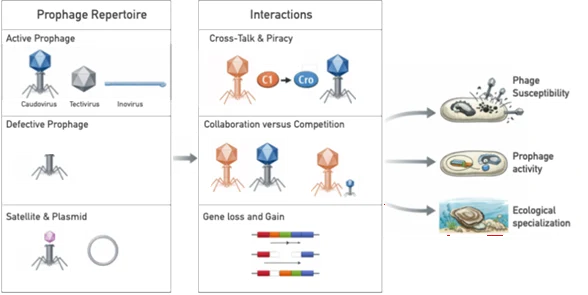
Bacterial genomes are not solitary entities but host dense assemblages of mobile genetic elements, including prophages, plasmids, and satellites. In polylysogenic bacteria, multiple prophages coexist within the same genome, yet the principles governing their organization and interactions remain unknown. This represents a gap in our understanding of phage-bacteria dynamics, still interpreted through simplified one phage-one host models.
Using the natural system Vibrio crassostreae, we recently showed that bacterial populations are structured by diverse and dynamic mobile elements, including active and cryptic prophages, as well as hybrid entities such as phage-plasmids and satellite-plasmids. These elements encode defense systems, regulatory modules, and recombination functions, suggesting that bacterial genomes behave as ecosystems of interacting genetic entities.
We propose that prophage coexistence is governed by underlying rules-based on compatibility, exclusion, and dependency-that determine which combinations of elements can persist within a genome. We further hypothesize that these interactions, rather than individual prophages alone, shape both phage infection outcomes and ecological specialization of bacterial populations across contrasting habitats.
To test this, we will integrate large-scale comparative genomics with targeted functional analyses to (i) redefine prophage diversity beyond current detection biases, (ii) uncover rules of coexistence among co-resident elements, and (iii) determine how these rules influence prophage activity, antiviral defense, phage susceptibility, and ecological specialization. By moving beyond reductionist models, this project will establish a new framework in which bacterial genomes are viewed as structured communities of mobile elements, reshaping our understanding of viral ecology, bacterial adaptation, and microbial evolution.
References
Liang et al. Complex temporal dynamics of phage-bacteria populations in an animal-associated marine system. Nature Communications, in press.
Laboratory website for recent publications and contact: lerouxlab.org
Development of ultraperformant data processing pipelines to drive Adaptive Closed-Loop Neurostimulation for Motor Recovery
Supervisor: Numa Dancause
The project’s overarching aim is to develop a pipeline that supports adaptive closed-loop neurostimulation system to advance personalized therapies for movement disorders and the next-generation neuroprostheses. It incorporates advanced signal processing and optimization approaches to ensure low-latency, high-accuracy, and adaptive operation. It is part of ongoing research effort in our group at the Pavillon Desmarais financed by Brain Canada : the platform EthoLab that will support neural recording and stimulation in animal models in the context of naturalistic behaviors.
The project integrates features derived from action potentials (spikes) and local field potentials, recorded from chronic intracortical microelectrode arrays, with synchronized behavioral data collected during motor tasks. By leveraging these complementary neural signals, the postdoctoral trainee will use data-driven models to decode movement-related brain states, including motor intent, preparation, and movement onset, in real time. This will enable state-dependent stimulation with precise temporal, spatial, and parametric control through optimization of timing, cortical target, dose, pulse width, and frequency.
The project will involve:
- Developing, analyzing, and optimizing real-time, data-driven pipelines for preprocessing and spike and LFP feature extraction from large-scale intracortical recordings.
- Conducting neural recording and neurostimulation studies in behaving non-human primates.
- Developing, training, and validating offline models using pre-recorded large-scale neural and behavioral datasets, including synchronized video and force-sensor measurements.
- Translating models from offline training to online closed-loop implementation in preclinical models.
Collaborating with interdisciplinary neuroscience, engineering, computational and clinical rehabilitation teams.
The lab is part of multiple research groups with research interest in fundamental biomedical research (CI2B), bridging neurosciences and artificial intelligence(Union Neurosciences et Intelligence Artificielle – Québec; UNIQUE), and brain function and learning(Centre Interdisciplinaire de Recherche sur le Cerveau et l’Apprentissage; CIRCA)
Mechanistic and structural dissection of let-7 maturation regulators
Supervisor: Pascale Legault
This project aims to define the mechanistic and structural basis of let-7 microRNA maturation by determining how specific regulatory proteins and complexes control distinct steps of miRNA biogenesis. Building on an RNA-centric interactome of the human let-7 family, expanded through integrated computational analyses and supported by initial functional validation, this project focuses on elucidating the roles of prioritized candidate regulators. Quantitative in vitro assays with purified components will be used to test direct interactions between candidate proteins, pre-let-7 RNAs, and core processing factors, including Dicer, Drosha, and Argonaute 2, to define how regulation occurs at distinct steps of miRNA maturation. Key regulatory assemblies will then be reconstituted and structurally characterized by cryo-electron microscopy, and structure-guided mutagenesis will link molecular interfaces to function, establishing a mechanistic and structural framework for miRNA regulation in development and disease.By specifically stimulating the reward circuits involved in motor learning, this approach could immediately improve motor skills while facilitating sustained recovery of voluntary control. The project aims to demonstrate the efficacy of this DBS modality, a technology used clinically for other indications (Parkinson’s, dystonia) but as yet unexplored for paralysis. Ultimately, this strategy could become an innovative clinical treatment for people living with paralysis.
For more information about the Legault lab, click HERE
Neurovascular interactions and cerebral blood flow regulation.
Supervisor: Ravi Rungta
We are seeking highly motivated postdoctoral fellows to join a multidisciplinary research program investigating neurovascular interactions and cerebral blood flow regulation.
Our lab research activities are centered around three main themes: 1) The relationship between neural circuit activity and hemodynamic signals, 2) The physiology and functions of brain pericytes, and 3) Neurovascular dysfunction in models of stroke and small vessel disease. We combine state-of-the-art optical methods, including two-photon, mesoscopic optical imaging, and ultrasound imaging, with molecular and pharmacological manipulations to probe neurovascular function in both healthy and disease contexts.
The lab offers a highly collaborative and interdisciplinary environment at the interface of neuroscience and engineering. Fellows will have the opportunity to develop independent, project-driven research programs while gaining expertise in cutting-edge imaging, quantitative analysis, molecular approaches.
Lab website: www.rungtalab.com
Innovation Fellow in Motor Cognition
Supervisors: Becket Ebitz & Matt Perich
The Ebitz and Perich labs in the Department of Neurosciences at the Université de Montréal are recruiting a postdoctoral fellow for a project at the interface of cognitive and motor control. The way that people respond to the world depends on the information we are holding in mind: working memory profoundly shapes sensorimotor control processes, even when the contents of that memory are completely irrelevant to the task at hand. The goal of this project is to understand how hierarchies of working memory shape sensorimotor control signals within large populations of neurons. The ideal candidate would focus on analyzing existing datasets and developing cutting-edge computational models. There is also an opportunity to lead causal perturbation studies that would combine large-scale neural recordings with electrical stimulation.
http://ebitzlab.com
Postdoctoral training in the neuroscience of naturalistic foraging behavior
Supervisor: Paul Cisek
Our lab studies the neural mechanisms of decision-making and interactive behavior using a combination of computational modeling and experimental techniques in humans and non-human primates. The successful applicant will lead innovative new experiments that examine how decisions are made during naturalistic foraging behavior. This will involve wireless multi-electrode recordings in the cerebral cortex and basal ganglia in two behavioral scenarios: 1) in a controlled virtual reality setting; and 2) during unconstrained behavior in a large enclosure equipped with cameras for automated motion capture. The applicant will help to design and conduct behavioral and neurophysiological experiments, analyze data, develop computational models of neural systems, prepare manuscripts for publication and participate in international conferences. Prior experience in experimental neuroscience is highly desirable, but we encourage applications from all students with a strong background in biology, psychology and/or mathematics and a passion for systems-level study of the brain. For more information, see: https://cisek.org/pavel/.
paul.cisek AT umontreal.ca
LINE-1 and Alu RNAs in RNA Metabolism and Immune Signaling
Supervisor: Daniel Zenklusen
The human genome harbors a vast repertoire of repetitive elements, many of which originate from retrotransposon insertions. Although the majority are epigenetically silenced, a subset remains transcriptionally active. These elements can be expressed either as independent transcriptional units or as part of host gene transcripts, particularly when embedded within introns.
Notably, the expression and/or stabilization of specific repeat elements-especially Alu and LINE-1 sequences- is frequently observed in cancer. Accumulating evidence indicates that these RNAs can engage and modulate innate immune signaling pathways. Despite these observations, the mechanistic basis underlying repeat element regulation, processing, and function remains poorly understood.
The project will employ a combination of single-molecule and super-resolution microscopy, alongside genomic and cell biological approaches, to uncover the mechanistic features of repeat element biology and their interplay with innate immune pathways, with a particular focus on LINE-1 and Alu RNAs.